We comment out a newly-added assert from the Bitcoin
side, because it's unclear how to replicate it
correctly in Elements.

Co-authored-by: Glenn Willen <gwillen@nerdnet.org>
The Elements 22 blinding logic has an edge case where when we drop change,
leaving only a single blinded output, we recompute a bunch of blinding
data to handle the potential for us to have 0 inputs and 1 output to blind.
(BlindTransaction will fail in this case because it cannot make the
transaction balance with only one output to mess with.)

In this recomputation, we dropped more data than we meant to, causing us
to incorrectly blind an output.
Modifies the getnewblockhex json rpc call to accept an array of
commitments instead of a single commitment.

Backwards compatibility is maintained by first attempting to parse as a
string for a singular commitment.
fadc4c7272 test: Add txindex migration test (MarcoFalke)
Pull request description:
Test for #22626
ACKs for top commit:
theStack:
Tested ACK fadc4c7272🌁
Tree-SHA512: fc7133ef52826bf0d4fa2ac72c3f1bed4a185ff7492396552ff2cbf6531b053238039211a710cbb949379c56875cd7715f1ed49a514dd3b3f1b46554e3d4bef5
The previous diff touched most files in ./test/, so bump the headers to
avoid having to touch them again for a bump later.

-BEGIN VERIFY SCRIPT-
./contrib/devtools/copyright_header.py update ./test/
-END VERIFY SCRIPT-
9de0d94508 doc: add disclaimer highlighting shortcomings of the basic multisig example (Michael Dietz)
f9479e4626 test, doc: basic M-of-N multisig minor cleanup and clarifications (Michael Dietz)
e05cd0546a doc: add another signing flow for multisig with descriptor wallets and PSBTs (Michael Dietz)
17dd657300 doc: M-of-N multisig using descriptor wallets and PSBTs, as well as a signing flow (Michael Dietz)
1f20501efc test: add functional test for multisig flow with descriptor wallets and PSBTs (Michael Dietz)

Pull request description:

  Aims to resolve issue https://github.com/bitcoin/bitcoin/issues/21278. I try to follow the steps laanwj outlined there exactly, with the exception of using `combinepsbt` instead of `joinpsbts`. I wrote a functional test to make sure it works as expected before doing the docs, and figured it would also be a good source of documentation. So I kept the test as simple as possible and didn't go crazy with edge-cases and various checks. I do have a lot more test-cases I've written that I will follow up with (either in a separate PR or another commit - lmk if you have a preference), but I want to do it in a way that doesn't bloat this test so it remains useful as a quickstart (unless that's a bad idea)?

ACKs for top commit:
  S3RK:
    Code review ACK 9de0d94. Rspigler's argument convinced me that we should leave the workflow with two wallets. I assume using multisig with external signers is a popular use-case and it's important to keep compatibility.
  laanwj:
    Code and documentation review ACK 9de0d94508

Tree-SHA512: 6c76e787c21f09d8be5eaa11f3ca3eaa4868497824050562bdfb2095c73b90f5e8987a8775119891d6bfde586e3f31ad1b13e4b67b0802e1d23ef050227a1211
4747da3a5b Add syscall sandboxing (seccomp-bpf) (practicalswift)

Pull request description:

  Add experimental syscall sandboxing using seccomp-bpf (Linux secure computing mode).

  Enable filtering of system calls using seccomp-bpf: allow only explicitly allowlisted (expected) syscalls to be called.

  The syscall sandboxing implemented in this PR is an experimental feature currently available only under Linux x86-64.

  To enable the experimental syscall sandbox the `-sandbox=<mode>` option must be passed to `bitcoind`:

  ```
    -sandbox=<mode>
         Use the experimental syscall sandbox in the specified mode
         (-sandbox=log-and-abort or -sandbox=abort). Allow only expected
         syscalls to be used by bitcoind. Note that this is an
         experimental new feature that may cause bitcoind to exit or crash
         unexpectedly: use with caution. In the "log-and-abort" mode the
         invocation of an unexpected syscall results in a debug handler
         being invoked which will log the incident and terminate the
         program (without executing the unexpected syscall). In the
         "abort" mode the invocation of an unexpected syscall results in
         the entire process being killed immediately by the kernel without
         executing the unexpected syscall.
  ```

  The allowed syscalls are defined on a per thread basis.

  I've used this feature since summer 2020 and I find it to be a helpful testing/debugging addition which makes it much easier to reason about the actual capabilities required of each type of thread in Bitcoin Core.

  ---

  Quick start guide:

  ```
  $ ./configure
  $ src/bitcoind -regtest -debug=util -sandbox=log-and-abort
  …
  2021-06-09T12:34:56Z Experimental syscall sandbox enabled (-sandbox=log-and-abort): bitcoind will terminate if an unexpected (not allowlisted) syscall is invoked.
  …
  2021-06-09T12:34:56Z Syscall filter installed for thread "addcon"
  2021-06-09T12:34:56Z Syscall filter installed for thread "dnsseed"
  2021-06-09T12:34:56Z Syscall filter installed for thread "net"
  2021-06-09T12:34:56Z Syscall filter installed for thread "msghand"
  2021-06-09T12:34:56Z Syscall filter installed for thread "opencon"
  2021-06-09T12:34:56Z Syscall filter installed for thread "init"
  …
  # A simulated execve call to show the sandbox in action:
  2021-06-09T12:34:56Z ERROR: The syscall "execve" (syscall number 59) is not allowed by the syscall sandbox in thread "msghand". Please report.
  …
  Aborted (core dumped)
  $
  ```

  ---

  [About seccomp and seccomp-bpf](https://en.wikipedia.org/wiki/Seccomp):

  > In computer security, seccomp (short for secure computing mode) is a facility in the Linux kernel. seccomp allows a process to make a one-way transition into a "secure" state where it cannot make any system calls except exit(), sigreturn(), and read() and write() to already-open file descriptors. Should it attempt any other system calls, the kernel will terminate the process with SIGKILL or SIGSYS. In this sense, it does not virtualize the system's resources but isolates the process from them entirely.
  >
  > […]
  >
  > seccomp-bpf is an extension to seccomp that allows filtering of system calls using a configurable policy implemented using Berkeley Packet Filter rules. It is used by OpenSSH and vsftpd as well as the Google Chrome/Chromium web browsers on Chrome OS and Linux. (In this regard seccomp-bpf achieves similar functionality, but with more flexibility and higher performance, to the older systrace—which seems to be no longer supported for Linux.)

ACKs for top commit:
  laanwj:
    Code review and lightly tested ACK 4747da3a5b

Tree-SHA512: e1c28e323eb4409a46157b7cc0fc29a057ba58d1ee2de268962e2ade28ebd4421b5c2536c64a3af6e9bd3f54016600fec88d016adb49864b63edea51ad838e17
Short options should only be a single character. If not, they can't be
concatenated in a single "-word" (from review by luke-jr).

F is chosen instead of f, because f could be reserved to the nested
wallet_hd.py (test_framework/test_framework.py) arguments parser.
18c5b23a0f [test] Test that -blocksonly nodes still serve compact blocks. (Niklas Gögge)
a79ad65fc2 [test] Test that getdata(CMPCT) is still sent on regular low bandwidth connections. (Niklas Gögge)
5e231c116b [test] Test that -blocksonly nodes do not send getdata(CMPCT) on a low bandwidth connection. (Niklas Gögge)
5bf6587457 [test] Test that -blocksonly nodes do not request high bandwidth mode. (Niklas Gögge)
0dc8bf5b92 [net processing] Dont request compact blocks in blocks-only mode (Niklas Gögge)
Pull request description:
A blocks-only node does not participate in transaction relay to reduce its own bandwidth usage and therefore does not have a mempool. The use of compact blocks is not beneficial to such a node since it will always have to download full blocks.
In both high- and low-bandwidth relaying the `cmpctblock` message is sent. This represent a bandwidth overhead for blocks-only nodes because the `cmpctblock` message is several times larger in the average case than the equivalent `headers` or `inv` announcement.
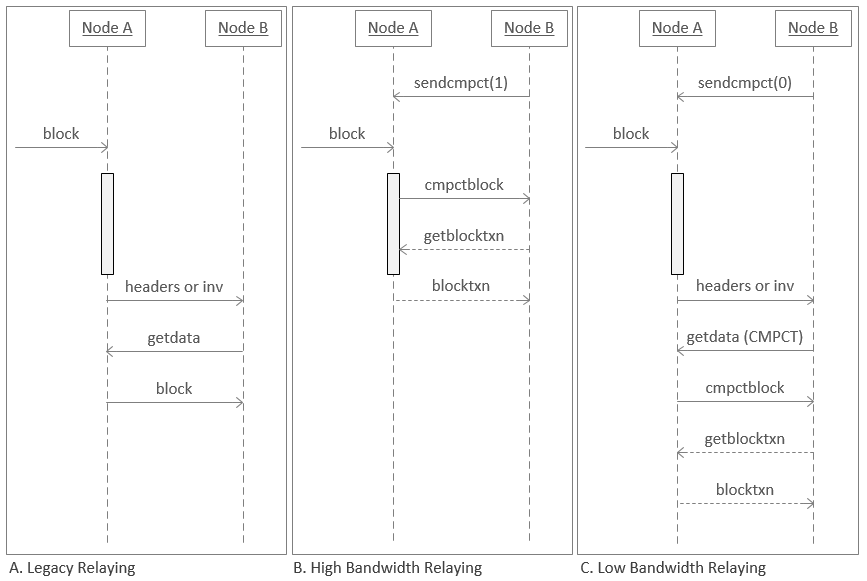
>**Example:**
>A block with 2000 txs results in a `cmpctblock` with 2000*6 bytes in short ids. This is several times larger than the equivalent 82 bytes for a `headers` message or 37 bytes for an `inv`.
## Approach
This PR makes blocks-only nodes always use the legacy relaying to download new blocks.
It does so by making blocks-only nodes never initiate a high-bandwidth block relay connection by disabling the sending of `sendcmpct(1)`. Additionally a blocks-only node will never request a compact block using `getdata(CMPCT)`.
A blocks-only node will continue to serve compact blocks to its peers in both high- and low-bandwidth mode.
ACKs for top commit:
naumenkogs:
ACK 18c5b23a0f
rajarshimaitra:
tACK https://github.com/bitcoin/bitcoin/pull/22340/commits/18c5b23a0f7adf9a08bcaa967ed800badf62d90a
jnewbery:
reACK 18c5b23a0f
theStack:
re-ACK 18c5b23a0f🥛
Tree-SHA512: 0c78804aa397513d41f97fe314efb815efcd852d452dd903df9d4749280cd3faaa010fa9b51d7d5168b8a77e08c8ab0a491ecdbdb3202f2e9cd5137cddc74624
240ea294d5 doc: update doxygen documention of ComputeTimeSmart() and AddToWalletIfInvolvingMe() regarding rescanning_old_block parameter (BitcoinTsunami)
d6eb39af21 test: add functional test to check transaction time determination during block rescanning (BitcoinTsunami)
07b44f16e7 wallet: fix ComputeTimeSmart algorithm to use blocktime during old block rescanning (BitcoinTsunami)
Pull request description:
The function ComputeTimeSmart in wallet.cpp assume that transaction are discovered in the right order.
Moreover the 'smarttime' determination algorithm is coded with realtime scenario in mind and not rescanning of old block.
The functional test demonstrate that if the user import a wallet, then rescan only recent history, and then rescan the entire history, the older transaction discovered would have an incorrect time determination.
In the context of rescanning old block, the only time value that as a meaning is the blocktime.
That's why I've fixed the problem with a simple separation between rescanning of old block and realtime time determination. The fix is written to have no impact on every realtime scenario and only impact the behaviour during a rescanning process.
This PR Fixes#20181.
To be fair, I don't think that this bug could be triggered with the wallet GUI, because it always proceed with a proper rescan.
But RPC API provide the possibility to trigger it. I've discovered it, because Specter desktop v0.10.0 was impacted. (https://github.com/cryptoadvance/specter-desktop/issues/680).
ACKs for top commit:
jonatack:
ACK 240ea294d5 per `git diff b92d552 240ea29`, re-verified rebase to latest master + debug build clean + new test passes on the branch and fails on master, only change since my review a few hours ago is incorporation of latest review suggestions
meshcollider:
re-utACK 240ea294d5
Tree-SHA512: 514b02e41d011ddfa325f5e8080b93800e1ea4ed5853fa420670a6ac700e8b463000dbea65f8ced8565cfb950c7f51b69154034dcb111e67aca3b964a0061494
43cd6b8af9 doc: add release notes for removal of the -deprecatedrpc=addresses flag (Michael Dietz)
2b1fdc2c6c refactor: minor styling, prefer snake case and same line if (Michael Dietz)
d64deac7b8 refactor: share logic between ScriptPubKeyToUniv and ScriptToUniv (Michael Dietz)
8721638daa rpc: remove deprecated addresses and reqSigs from rpc outputs (Michael Dietz)
Pull request description:
Resolves#21797 now that we've branched-off to v23 ("addresses" and "reqSigs" deprecated) "ExtractDestinations" should be removed.
`-deprecatedrpc=addresses` was initially added in this PR #20286 (which resolved the original issue #20102).
Some chunks of code and logic are no longer used/necessary with the removal of this, and therefore some minor refactoring is done in this PR as well (separated commits)
ACKs for top commit:
MarcoFalke:
re-ACK 43cd6b8af9🐉
meshcollider:
Code review ACK 43cd6b8af9
jonatack:
ACK 43cd6b8af9 per `git range-diff a9d0cec 92dc5e9 43cd6b8`, also rebased to latest master, debug built + quick re-review of each commit to bring back context, and ran tests locally at the final commit
Tree-SHA512: fba83495e396d3c06f0dcf49292f14f4aa6b68fa758f0503941fade1a6e7271cda8378e2734af1faea550d1b43c85a36c52ebcc9dec0732936f9233b4b97901c
Messy merge conflicts because this PR backported some ad-hoc stuff from
upstream while keeping a few things that upstream deleted. Hopefully
reviewing is easier than doing this in the first place, since ultimately
all I did was delete code from one side or another of the conflicts.
(Ok, I also changed some boost optional stuff to std::optional, and had
to patch up a test file for test framework changes.)

When reviewing the detailed crypto, bear in mind that taptweaks, like all
hashes are the kind of crypto that cannot be subtly wrong -- it will either
fail very hard or be correct. And we have independent implementations in
C++ and Python that cross-check each other, si it's unlikely to be the former.
This forward-ports the new Taproot sighash but does not fix a couple
22-blocked TODOs related to the MissingDataBehavior enum. Should be fixed
in a followup commit.

One nontrivial change I had to make was feeding the genesis hash to SignTransaction
(the "global" one in script/sign.cpp) so that it could correctly compute
the sighash at signing time.
This commit addresses #20809.

We add an additional 'error' property in the result of 'validateaddress' in case the address is not valid that gives a short description of why the address in invalid. We also change the error message returned by 'getaddressinfo' in case the address is invalid.

https://github.com/bitcoin/bitcoin/pull/20832 (1/1)

ELEMENTS: Merge conflicts resolved based on d6c85c5620 (from 22.0 rebase)

