What a pain in the ass. This changes the `feature_cltv` functional test
to use the `MiniWallet`, an internal Pythonic wallet that produces
"signatures" consisting of several OP_NOPs in a row, so that this test
can be used when the wallet is disabled.

This means that the functions in feature_cltv which add a CLTV check and
change the locktime/sequence number no longer need to re-sign when they
change the txid, so they don't...HOWEVER, our Elements-specific
`feature_block_v4` test calls these functions with a real transaction
and depended on the re-signing behavior.

After several attempts at min-effort min-diff fixes I landed on this,
which simply sets the locktime at transaction creation and avoids having
to re-sign at all.

Also, I had to change the number of NOPs in the fake wallet code to make
a vsize assertion pass, presumably because of differences in Bitcoin/Elements
transaction serialization.
This is part of the "UTXO Set Statistics" project in Core, which aims
to make things like "checking coin supply" faster. This stuff, and
related things in coinstats.cpp, have always been broken for Elements
in the sense that we consider only explicit outputs and we ignore
assets (so everything just gets added together to get a meaningless
total). It probably wouldn't be too hard to restrict this to only
consider policyAsset, but it's out of scope for a rebase IMO.

Also, I think this situation is fine .. I don't understand the motivation
for this or why Core is merging this when they refuse to merge an address
index .. but I guess we'll see if there are users who care about this data
and who care about it being meaningful on Elements.

Also, apologies for the big diff -- there were some mechanical changes
to deal with CT amounts, but most of the changes related to the difference
in how fees are accounted for. While I'm not thrilled with this PR, its
functional test is really good! So I think what I eventually came up with
is internally consistent.
There are a few layers of bullshit to this PR.

First, there is the fact that it adds a functional test gated on a new
config flag which is disabled by default, so it actually adds broken
code with no tests, waiting to ruin your day 520 PRs later when #21935
enables the broken test.

Second, the test appears to be superficially nonsensical because it
generates two transactions from different wallets and tries to compare
them for byte-for-byte equality, which doesn't make sense (at least)
because change outputs are randomly located...so something fishy is
going on.

Of course, in Elements the transactions are *not* equal half the time
because the outputs are permuted, which may have let me quickly figure
out the issue, except...

Third, there is a red herring of a bug where the two transactions have
slightly different feerates. This turns out to be caused by
CWallet::CalculateMaximumSignedTxSize using differently sized dummy
transactions depending on whether watchonly outputs are included (this
fact is conveniently disguised by #17211 slightly changing this logic;
this is an unmerged PR in Core that Elements has a backport of an old
version of). And the two wallets have different watchonly settings.

A sub-red-herring is the fact that this bug results in a discrepancy
of 0.25 vbytes, so it does not appear in Core but does appear in
Elements (there is a 3/16 probability that we should be so unlucky...
we are).

But this is all irrelevant, because...

Fourth, this test is actually super bullshit. The way it works is by
constructing a PSBT legitimately, saving this to disk, then re-"signs"
using the external signer interface by using a mock signer that
COMPLETELY REPLACES THE TRANSACTION UNDER CONSTRUCTION. So it doesn't
matter what the fee output looks like and it doesn't matter what the
order of the outputs. Core does not detect this malfeasance and
neither does Elements. For some reason, Core has a functional test
that explicitly checks that you can do this even though it is insane
and it is hard to think of non-malicious reasons to do it.

Fifth, while Elements fails to detect that its external signer is
actually changing the transaction out from under it, it DOES assume
that this won't happen. In CWallet::SignPSBT it blithely un-replaces
the transaction, which undermines the functional test.

Sixth, the original PR where this test was introduced has comments
locked, so anyone who spent six hours reverse-engineering this idiotic
broken test, and is still feeling charitable enough to discuss it with
the Core developors, can go pound sand.

Anyway, just disabled the broken test and move on with our lives.
bdb8b9a347 test: doc: improve doc for `from_hex` helper (mention `to_hex` alternative) (Sebastian Falbesoner)
1914054208 scripted-diff: test: rename `FromHex` to `from_hex` (Sebastian Falbesoner)
a79396fe5f test: remove `ToHex` helper, use .serialize().hex() instead (Sebastian Falbesoner)
2ce7b47958 test: introduce `tx_from_hex` helper for tx deserialization (Sebastian Falbesoner)
Pull request description:
There are still many functional tests that perform conversions from a hex-string to a message object (deserialization) manually. This PR identifies all those instances and replaces them with a newly introduced helper `tx_from_hex`.
Instances were found via
* `git grep "deserialize.*BytesIO"`
and some of them manually, when it were not one-liners.
Further, the helper `ToHex` was removed and simply replaced by `.serialize().hex()`, since now both variants are in use (sometimes even within the same test) and using the helper doesn't really have an advantage in readability. (see discussion https://github.com/bitcoin/bitcoin/pull/22257#discussion_r652404782)
ACKs for top commit:
MarcoFalke:
review re-ACK bdb8b9a347😁
Tree-SHA512: e25d7dc85918de1d6755a5cea65471b07a743204c20ad1c2f71ff07ef48cc1b9ad3fe5f515c1efaba2b2e3d89384e7980380c5d81895f9826e2046808cd3266e
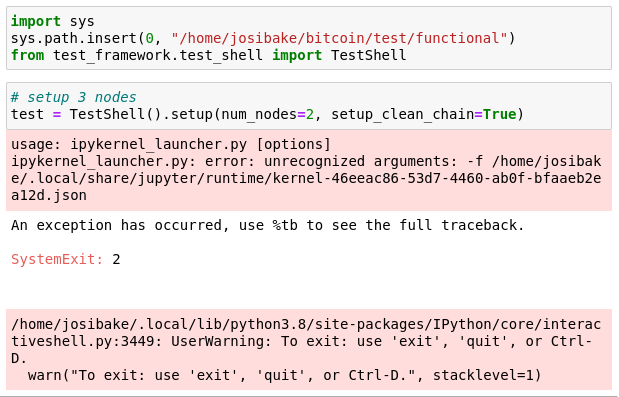
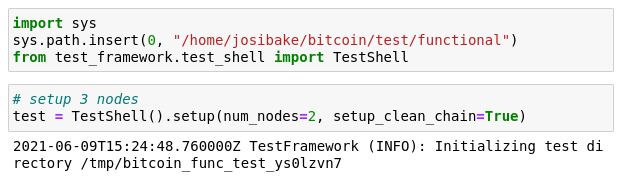
testshell in jupyter was failing due to an extra arg.
this adds a dummy -f param, which allows TestShell to
be used in a command line or jupyter environment
d6d2ab9845 test: MiniWallet: fix fee calculation for P2PK and check tx vsize (Sebastian Falbesoner)
ce024b1c0e test: MiniWallet: force P2PK signature to have fixed size (71 bytes) (Sebastian Falbesoner)

Pull request description:

  This PR is a follow-up to #21945. It aims to both fix the fee calculation for P2PK mode transactions and enable its vsize check. Currently, the latter assumes a fixed tx length, which is fine for anyone-can-spend txs but doesn't apply to P2PK output spends due to varying DER signature size; the vsize check is therefore disabled for P2PK mode on master branch.

  Creating one million DER signatures with MiniWallet shows the following distribution of sizes (smart people with better math skills probably could deduce the ratios without trying, but hey):

  | DER signature size [bytes]  | #occurences (ratio) |
  | ------------- | ------------- |
  | 71  | 498893 (49.89%) |
  | 70 | 497244 (49.72%) |
  | 69 | 3837 (0.38%) |
  | 68 | 22 (0.0022%) |

  Note that even smaller signatures are possible (for smaller R and S values with leading zero bytes), it's just that the probability decreases exponentially.     Instead of choosing a large vsize check range and hoping that smaller signatures are never created (potentially leading to flaky tests), the proposed solution is ~~to limit the signature size to the two most common sizes 71 and 70 (>99.6% probability) and then accordingly only check for two vsize values; the value to be used for fee calculation is a decimal right between the two possible sizes (167.5 vbytes) and for the vsize check it's rounded down/up integer values are used.~~ to simply grind the signature to a fixed size of 71 bytes (49.89% probability, i.e. on average each call to `sign_tx()`, on average two ECC signing operations are needed).

  ~~The idea of grinding signatures to a fixed size (similar to https://github.com/bitcoin/bitcoin/pull/13666 which grinds to low-R values) would be counter-productive, as the signature creation in the test suite is quite expensive and this would significantly slow down tests that calculate hundreds of signatures (like e.g. feature_csv_activation.py).~~

  For more about transaction sizes on different input/output types, see the following interesting article: https://medium.com/coinmonks/on-bitcoin-transaction-sizes-97e31bc9d816

ACKs for top commit:
  MarcoFalke:
    Concept ACK d6d2ab9845

Tree-SHA512: 011c70ee0e4adf9ba12902e4b6c411db9ae96bdd8bc810bf1d67713367998e28ea328394503371fc1f5087a819547ddaea56c073b28db893ae1c0031d7927f32